DwarfStar 4: how a 284B model runs on a MacBook
DwarfStar, still ds4 on GitHub, is a local inference engine by Salvatore Sanfilippo (antirez), the creator of Redis. It runs DeepSeek V4 Flash, one of the most capable open-weight models released, on a 128 GB MacBook Pro or an NVIDIA DGX Spark at real, usable speeds. On paper that should not work: 284 billion parameters, stored the normal way, is 568 GB of memory, more than four times what those machines have. Sanfilippo writes that it is the first time he has used a local model for the serious work he would normally send to a frontier API, and the claim has weight behind it: the repo sits at 13.5k stars and the launch post drew 440 points on Hacker News. In this post I want to show you how it works. The answer comes in two parts: a quantization recipe that gets the model into 128 GB without ruining it, and an SSD streaming design that makes even that number negotiable.
The RAM cliff
Local inference has a brutal property: it is binary. Store 284 billion parameters as 16-bit numbers and you need 568 GB for the weights alone. Cut every weight to 8 bits and you are still at 284 GB, more than double what a 128 GB machine has. There is no partial credit. Either the model fits in memory or it does not run at all. There is no “runs a bit slower.” I think of it as the RAM cliff: small models stand safely on top, and the models worth running fall straight off the edge into API-only territory.
The standard escape hatch is quantization, which just means storing each weight with fewer bits. At 4 bits, models hold up surprisingly well. The problem is that 4 bits is not enough here. To get 284B parameters under 128 GB, you need to push toward 2 bits, which leaves exactly four representable levels per weight. Historically that is where quality falls off a cliff of its own: important weights get snapped to wrong values, the error feeds the next layer, and 43 layers later a small rounding error has compounded into a different, worse model. Naive 2-bit quantization saves the memory and throws away the intelligence. DwarfStar’s answer is to not quantize everything.
Quantize the furniture, not the walls
The trick depends on what this model is made of. DeepSeek V4 Flash is a mixture-of-experts model. Inside each of its 43 layers, a router chooses among 256 experts, small feed-forward networks, and only a handful fire per token, plus one shared expert that every token passes through. Add it up and the model is 284B parameters total but only about 13B active per token. The model is huge; per token, it is small.
That anatomy is what makes the trick possible. Think of the model as a building. Attention, the routers, the shared experts, the output head: those are the load-bearing walls. Every token flows through them, so damage there propagates everywhere. The routed experts are the furniture: they are most of the building by mass, but each token only ever touches a few pieces.
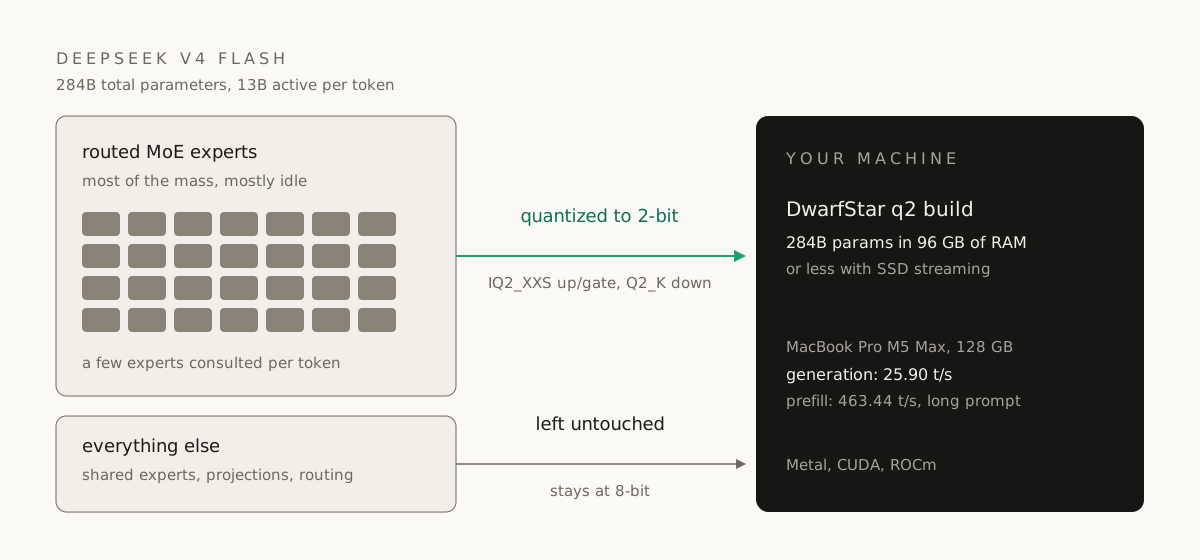
The recipe, straight from the repo, is to crush the furniture and protect the walls. Routed experts get squeezed to roughly 2 bits (IQ2_XXS for up and gate projections, Q2_K for down), and everything load-bearing stays at 8 bits, effectively untouched. This survives where naive 2-bit quantization does not, for two reasons. With 256 experts per layer there is redundancy. And any single token meets only a few quantized experts, sandwiched between high-precision layers, so the error never gets the chance to compound the way it does in a dense model. The result: the model drops from 568 GB to about 81, under the 128 GB of a MacBook Pro. As the README puts it, these 2-bit quants are not a joke.
Quantize with your eyes open, then prove it
“It fits” is easy to verify. “It is still smart” needs measurement, and DwarfStar does two things most quantization projects skip. The first is calibration. Before quantizing, the project runs the model over a calibration corpus of about 4,700 real prompts, roughly 2.9 million tokens of code review, contest math, long documents, and agent tool calls, and records which weight columns carry signal. The quantizer then protects the heavily used columns and lets the rarely used ones absorb the error. The detail I like most: the calibration set includes tool-calling prompts in DeepSeek’s own format, so the quantization is tuned for agentic work, exactly where cheap quants usually fall apart first.
The second is proof. DwarfStar validates against continuation vectors captured from the official DeepSeek API, measuring token by token how much probability the local 2-bit model assigns to the exact tokens the full model produces. If the quant were damaged, the curves would split. They track. On top of that sits a built-in 92-question evaluation gate, 25 GPQA Diamond, 25 audited SuperGPQA, 25 AIME 2025, and 17 security code review items, run as the engine evolves. “The model survived” is a measured claim here, not a vibe.
The cliff becomes a dial
All of that assumes 128 GB. For machines with less, say 64 GB, DwarfStar has SSD streaming, and it is my favorite part of the system.
In streaming mode, the load-bearing weights stay permanently resident in RAM, because every token needs them. Next to them, the engine carves out a pinned cache of slots, each holding one complete expert. The full set of experts, all eleven thousand or so across 43 layers, stays on the SSD inside the model file. When the router picks experts that are already cached, that is a hit: fast path, no disk. When one is missing, the engine reads that single expert off the SSD, drops it into a slot, and evicts whichever expert has been cold the longest. Expert usage follows a power law, some experts are simply popular, so a profiled hotlist preloads the popular ones at startup and the cache starts warm.
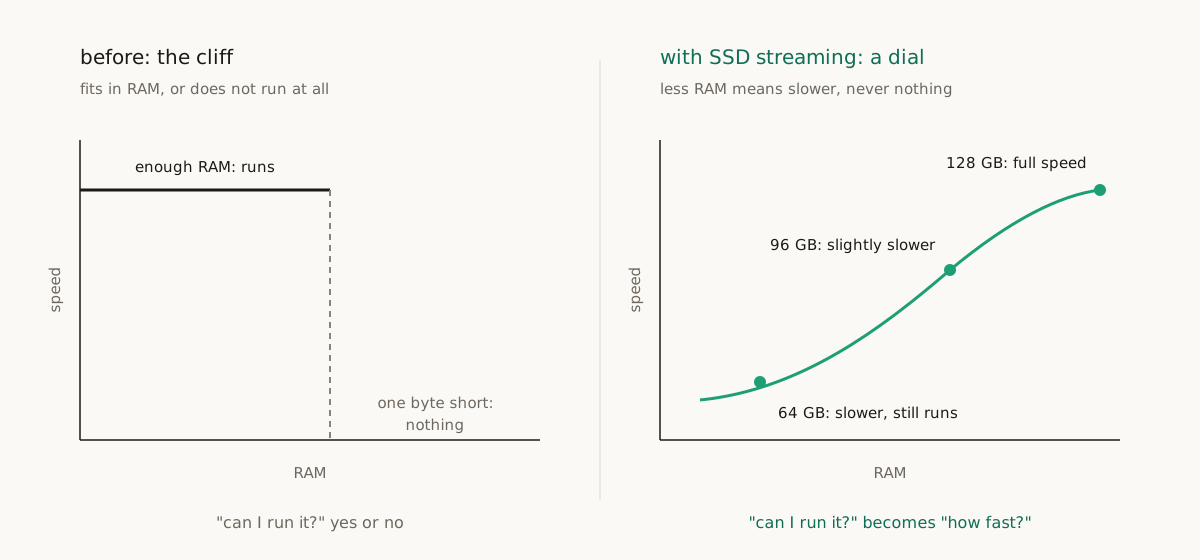
This removes the RAM cliff. RAM stops being a hard cutoff and becomes a continuous spectrum of speed levels: 128 GB runs everything resident at full speed, 96 GB runs a big cache slightly slower, 64 GB runs a smaller cache with more misses, slower still, but it always runs. The question is no longer “can I run this model?” It is “how fast?” Your laptop’s SSD just joined the memory hierarchy for AI.
Your conversation is a file
Weights are only half the memory story. The other half is the KV cache, the model’s working memory of your session, which on a classic architecture can outgrow the model itself at long context. DeepSeek V4’s layered attention design keeps the most recent 128 tokens raw at full resolution and compresses older history along time, alternating by layer between pooling four tokens into one (with an indexer that attends to the most relevant 512 rows) and compressing 128 into one. A million tokens of context lands around 26 GB: big, but something a laptop can hold.
Because the cache is compact, DwarfStar treats it as a first-class disk citizen. Sessions are saved as checkpoint files and resume with zero re-processing of the prompt. A two-hour coding session with a 284B model is a file you can come back to tomorrow.
Two MacBooks, one model
DwarfStar also does distributed inference. Connect two MacBooks with a Thunderbolt 5 cable (0.45 ms ping), split the model by layers, and prompt processing becomes an assembly line: while machine B chews on chunk one, machine A is already on chunk two. The pipeline pays off on prefill: 1.38x at 9k tokens, 1.66x at 28k, 1.85x at 64k. Generation is the honest footnote: one token at a time collapses the pipeline into ping-pong across the cable, about 19% slower. So this mode is for fitting bigger models and processing long prompts faster, not for faster typing.
The payoff at the top end: two Mac Studios run DeepSeek V4 PRO, the full 1.6 trillion parameter model, at around 11.5 tokens per second. And a single 512 GB Mac Studio runs the PRO 2-bit build at 9.6 tokens per second with 32k context. Frontier-scale weights, on a desk.
The scoreboard
From the repo’s published benchmarks for the 2-bit Flash build, long prompts: an M3 Max MacBook generates around 21.5 tokens per second, an M5 Max around 25.9, an M3 Ultra Studio 27.4, and the DGX Spark 13.8. Prefill is where these machines fly: 250 to 468 tokens per second. Readable speeds, for a model this size, on hardware you own.
Why this matters
Three things stand out beyond the single project. First, it shows what you get when one team owns the whole stack, the engine, the quantization, the validation, even the coding agent, and tunes them for each other instead of trying to be maximally general. That is the same lesson the harness world keeps teaching: the integration is the product. Second, the cliff-to-dial reframing changes what “consumer hardware” means for AI, because the SSD is now part of the memory hierarchy. And third, this is quasi-frontier intelligence running fully local: there are no API keys or rate limits, and your data never leaves the machine. That is the bet I have been making since localGPT, and DwarfStar is the strongest evidence yet that the bet is right.
Sources
- DwarfStar (ds4) on GitHub, the engine, benchmarks, and validation suite
- A few words on DS4, antirez’s launch post
- DeepSeek V4 announcement, Flash: 284B total, 13B active, 1M context, open weights
- Hacker News discussion
- What is an agent harness? and RAG beyond similarity search, companion essays on this site