RAG beyond similarity search: how a modern retrieval pipeline works
Traditional RAG is the recipe most people still follow: retrieve the relevant pieces, put them in context, generate. That recipe hasn’t changed since 2023, and it degrades in production in ways that are hard to pin down. The demo goes fine, then a few weeks into real use the answers start going wrong. In this post I want to show the exact places the traditional pipeline breaks, the techniques that fix each break, and how they come together in localGPT, my open-source project, as one concrete end-to-end architecture that runs entirely on local models.
The three-step recipe, and where it cracks
The classic pipeline is three steps.
First, indexing: split your documents into chunks, run each chunk through an embedding model, and store the vectors in a vector store. A vector store sounds fancy but it’s basically a database of number lists, one list per chunk. Second, retrieval: embed the user’s query with the same model and run a similarity search, which just means finding the chunks whose numbers sit closest to the query’s numbers. Third, generation: paste the top-k chunks into the prompt and let the model answer.
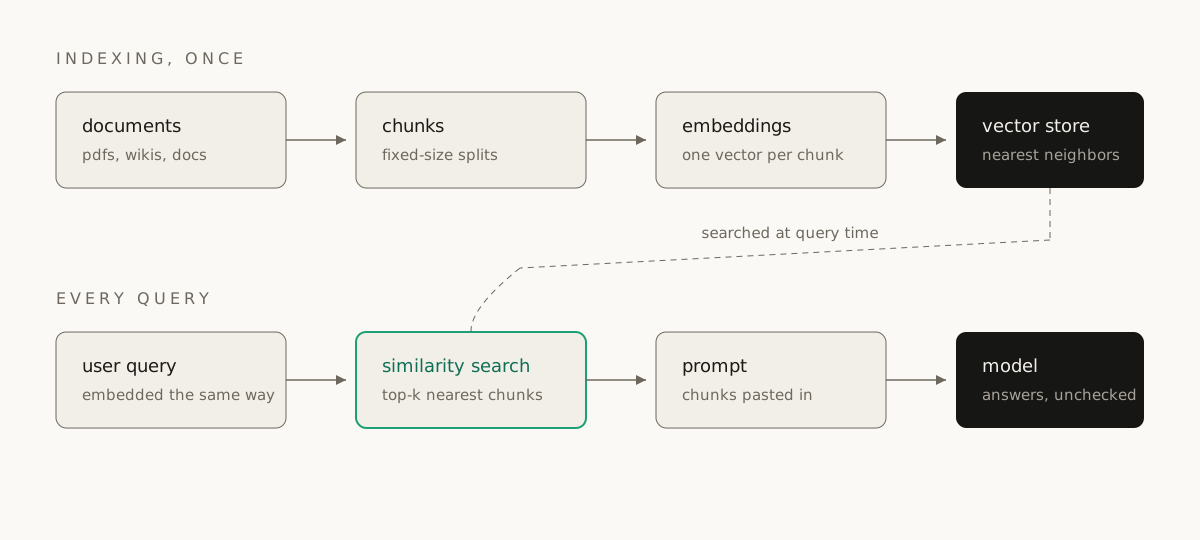
For a small clean corpus this works well, which is why demos go fine. Then the corpus grows, the questions get harder, and four failure modes show up:
- Chunks lose their context. Chunking cuts a document into pieces, so each piece forgets the page it came from. A chunk that says “the second approach performs better” embeds to something nearly meaningless once it’s separated from the section that defined the approaches.
- Similarity is not the same as relevance. Dense vectors capture meaning, so they blur exact strings: part numbers, function names, legal clause IDs. The query “error 0x80070057” wants keyword search, not semantic neighbors.
- Top-k is noisy. The nearest 10 chunks usually contain the answer plus six distractions, and the model doesn’t reliably ignore the distractions.
- Nothing checks the answer. If retrieval misses, the model improvises, and the pipeline reports the improvisation with full confidence. You won’t see this in a demo, because in a demo you already know the right answer.
The diagnosis is four specific breaks, not one vague “RAG doesn’t work.” A specific break can get a specific fix, and each technique in the next section fixes exactly one of these four.
What works today
Hybrid search. This fixes the exact-string problem, and it’s the cheapest fix of the set. Run dense vector search and keyword (BM25) search in parallel, then fuse the results. Dense covers paraphrases and concepts, keywords cover the strings dense embeddings blur, like “error 0x80070057”. In my experience this is the single highest-value upgrade over vector-only retrieval. Fusing two searches does return more candidates, which makes the noise problem worse, so it pairs with the next technique.
Reranking. This fixes the noise problem. Cast a wide net on purpose, say k of 20 or more, then let a second model score each candidate against the query and keep the best few. That second model is a cross-encoder, which is just a model that reads the query and the chunk together instead of comparing two precomputed vectors. Rerankers like answerai-colbert-small-v1 are far more accurate than the original similarity score for exactly that reason.
Contextual enrichment. This is the first of two fixes for the context problem. Before embedding, prepend each chunk with a short generated summary of its surrounding context, an approach popularized by Anthropic’s contextual retrieval. The chunk that says “the second approach performs better” now carries a sentence explaining which approaches, from which section, so its embedding finally means something on its own. The enrichment happens once, at indexing time, so you pay for it once per document, not once per query.
Late chunking. This is the second fix for the context problem, attacking it from the embedding side. The idea comes from the late chunking paper: embed the entire document in one pass, then pool the token representations within each chunk’s span. Every chunk’s vector is computed while the model can still see the whole document, so the context survives even though the storage unit is still a chunk.
Query decomposition. This works on the query side. Real questions are often three questions wearing a coat. Split a complex query into standalone sub-queries, run retrieval for each in parallel, and compose the sub-answers. This also handles follow-ups: the decomposer resolves “what about the second one?” against chat history before searching, so the retrieval step never sees a dangling pronoun.
Sentence pruning. Even after reranking, a well-ranked chunk is mostly padding. A pruning model like Provence removes the irrelevant sentences inside each retrieved chunk, so the context window carries answers, not upholstery.
Answer verification. This fixes the fourth failure, the unchecked answer. After generation, an independent check compares the answer against the retrieved evidence and issues a verdict: supported or not. It’s the step that turns “the model said something” into “the system stands behind this,” and it’s the piece most pipelines still skip.
How localGPT puts it together
localGPT started in 2023 as exactly the traditional pipeline: embed documents, store vectors, search, answer, all locally for privacy. The current architecture is what it grew into after hitting every one of the four failures above. Every model in it runs on your machine through Ollama, which makes it a useful existence proof: none of this requires a cloud API.
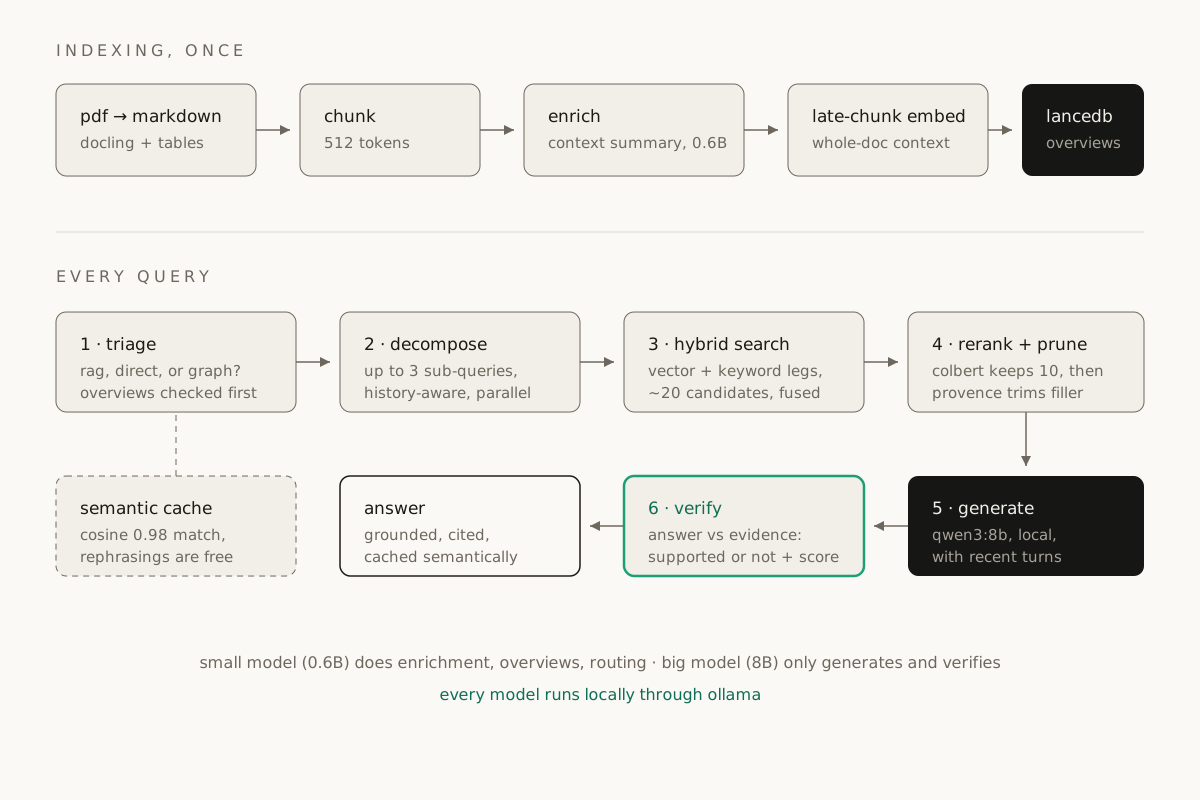
On the indexing side:
- Documents are converted to structured markdown with Docling, which preserves layout and tables instead of scraping raw text.
- Chunks are cut at 512 tokens, respecting markdown structure.
- Each chunk gets contextual enrichment: a small local model (qwen3:0.6b) writes a few sentences of surrounding context, which are prepended before embedding.
- Embeddings use Qwen3-Embedding-0.6B with late chunking enabled, and land in LanceDB.
- A one-paragraph overview of each document is precomputed and stored alongside the index. These overviews are used at query time for triage.
The indexing lane applies both context fixes at once, enrichment and late chunking. On the query side, retrieval is not a fixed step. It’s a decision:
- Triage. The agent first decides what kind of query this is, using the precomputed document overviews for a fast check and a small LLM as fallback. Some queries route to retrieval, some get answered directly, and follow-ups default to retrieval because history suggests the documents are in play.
- Decomposition. Complex queries are split into up to three standalone sub-queries, with pronouns resolved against the conversation, and the sub-queries run through the pipeline in parallel.
- Hybrid retrieval. Vector search and keyword search run in parallel against LanceDB, fetch about 20 candidates, and fuse.
- Rerank and prune. A ColBERT reranker keeps the best 10, with an early exit when the leader’s margin is already decisive. Provence then prunes irrelevant sentences inside the survivors.
- Generate. qwen3:8b answers from the pruned context, with recent conversation turns included.
- Verify. An independent verification pass compares the answer to the evidence and returns a verdict with a confidence score, so the system knows the difference between grounded and improvised.
Two design choices are worth stealing even if you never run the project. First, the multi-model split: a 0.6B model handles enrichment, overviews, and routing, while the 8B model only generates and verifies. Routine work goes to cheap models and judgment goes to the big one. Second, the semantic cache: repeated queries are matched by embedding similarity (cosine 0.98), not exact string match, so rephrasings of yesterday’s question cost nothing.
Retrieval is becoming agentic
The traditional pipeline has one more failure the four above don’t cover: it never decides anything. It retrieves on every query, the same way, whether or not retrieval is the right move. The localGPT query path is different: triage, decompose, search, check, and then decide whether the evidence is good enough. That’s not a pipeline so much as a small agent whose tools happen to be a vector store and a keyword index. The most interesting RAG systems today are converging on the same shape as the agent harnesses I wrote about in the harness series: a loop with retrieval tools, a decision maker in the middle, and a verifier at the end.
That’s where I’d place the frontier: not better embeddings, but better decisions about when to retrieve, what to retrieve, and whether to trust what came back. The traditional pipeline treated retrieval as plumbing. The systems that work treat it as judgment.
Sources
- localGPT, the architecture described here
- Contextual retrieval, Anthropic
- Late chunking: contextual chunk embeddings using long-context embedding models
- answerai-colbert-small-v1, the reranker
- Provence, sentence-level context pruning
- Docling, document conversion
- What is an agent harness?, where retrieval meets the agent loop