Harness engineering: why agent performance now lives outside the model
A harness is everything around a language model that turns it into an agent: the orchestration code, system prompts, tools, memory, and verification loops. It matters because the harness now drives more of the performance difference between agents than the model does. Stanford researchers measured more variation coming from orchestration code than from the choice of model. LangChain rebuilt only the infrastructure around their coding agent, touched no model, and jumped from outside the top 30 to rank five on Terminal-Bench 2. On the same model, the gap between a good harness and a bad one can reach six times.
In March 2026, two papers turned this layer into something you can measure and engineer: Natural-Language Agent Harnesses from Tsinghua and Meta-Harness from Stanford. I covered what a harness is, and the nine components of a good one, in a companion essay. In this post I want to walk through the evidence: what happens when researchers make the harness explicit, measure it, and let machines optimize it.
An agent is a model plus a harness
First, a working definition. LangChain frames it with the sharpest line in the field: if you’re not the model, you’re the harness.
An operating system is a useful analogy. The LLM plays the CPU. The context window is RAM, fast but scarce. External databases stand in for disk. Tool integrations are the device drivers. The harness is the operating system: it schedules the processor, decides what reaches it, and turns raw cycles into finished work. The weights do the thinking, but the harness decides what there is to think about.
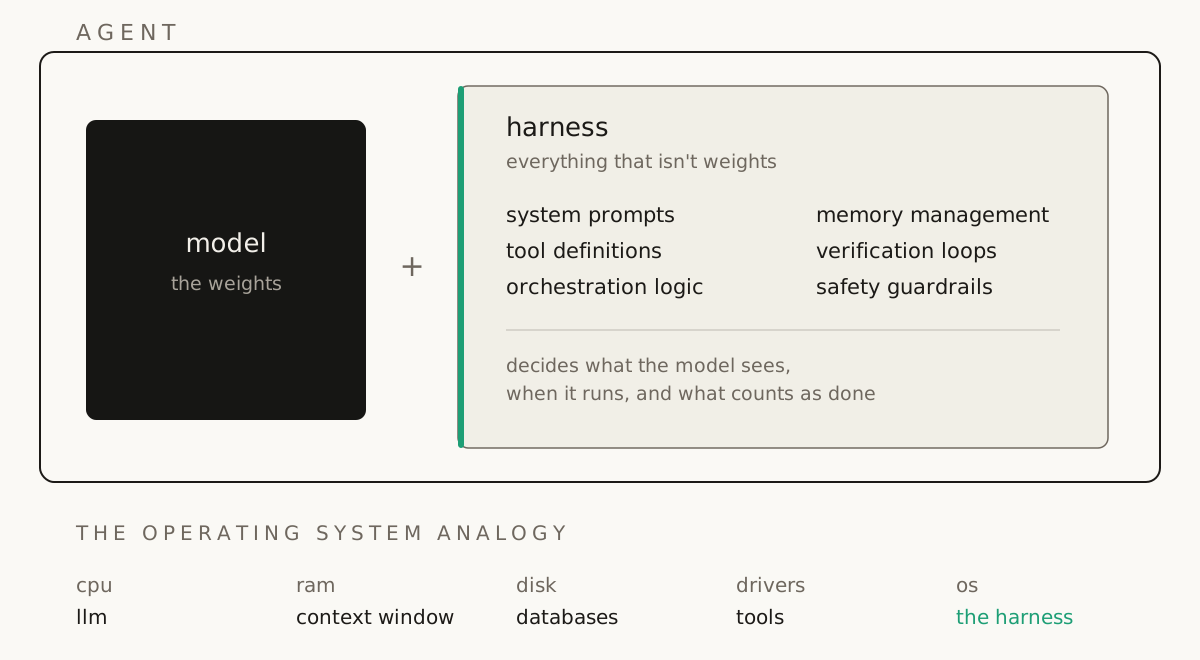
Concretely, the harness is everything that isn’t model weights: system prompts, tool definitions, orchestration logic, memory management, verification loops, safety guardrails. Anthropic identified five canonical patterns for it: prompt chaining, routing, parallelization, orchestrator-workers, and evaluator-optimizer loops. Each is a different strategy for when and how the model gets called, and every production agent combines them. Those architectural choices are where the six-times gaps live, not the weights underneath.
Why nobody could measure it
If the harness matters this much, why wasn’t anyone engineering it carefully before? The honest answer is that until recently, nobody could even see the harness clearly. It gets built by accretion.
Harness logic ends up scattered across controller code, framework defaults, and verifier scripts, so no one can point to it as a single object. The Tsinghua authors note that two systems which nominally differed by one design choice actually differed in prompts, tools, verification gates, and state semantics simultaneously. You can’t run a controlled experiment on a variable you can’t isolate, so nobody did.
Anthropic’s own evolution shows what building blind looks like. Naive harnesses suffer two failure modes: one-shotting, where the agent tries everything at once and exhausts its context, and premature completion, where a later session sees partial progress and declares victory. Their fix evolved into a three-agent, GAN-inspired architecture: a planner, a generator, and an evaluator that clicks through the running app like a real user. It was twenty times more expensive, roughly $200 per run instead of $9, but the system finally worked end to end. They got to a working harness by trial and error, not by measurement.
OpenAI converged on the same place independently. One internal effort produced a million lines of application logic, tests, CI, and tooling in five months with zero lines written by hand, and the team’s discovery was that their primary job had become enabling agents to do useful work. Productive, but ad hoc, non-portable, and impossible to ablate.
Standards did start to emerge around the edges. AGENTS.md reached 60,000 repositories, and Anthropic’s agent skills added reusable procedures. But both package components, conventions, and snippets, not the full harness itself. What the field needed was harness logic made explicit and executable, something you could hold constant, swap out, and measure.
The Tsinghua paper: a harness written in natural language
The Tsinghua team asks a simple question: what if you could write an agent’s entire control logic in structured natural language instead of Python or YAML?
Their Natural-Language Agent Harness (NLAH) separates an agent into three layers: the backend (infrastructure and tools), a runtime charter (the universal physics: how contracts bind, how state persists, how child agents are managed), and the NLAH itself (task-specific control logic: contracts, roles, state structure, failure taxonomies).
That separation fixes the measurement problem. Swap the NLAH while fixing the charter and you’re testing harness design. Fix the NLAH while swapping the charter and you’re testing runtime policy. Clean ablation, at last.
Two mechanisms make the natural-language version trustworthy enough to run. Execution contracts turn fuzzy LLM completions into bounded agent calls with five elements: required inputs, budgets, permissions, completion conditions, and output paths. A contract does for an agent call what a function signature does for code, which is to say it pins down what goes in and what must come out. And file-backed state externalizes memory to path-addressable files, plain files on disk that survive truncation, restarts, and delegation.
The first result is about cost, not accuracy. On SWE-bench Verified with GPT-5.4 at maximum reasoning, resolve rates clustered between 74% and 76% regardless of configuration. But the full harness burned 16.3 million prompt tokens per sample across 642 tool calls and 32 minutes, and the stripped-down version got there in 1.2 million tokens, 51 calls, under 7 minutes. Same destination, fourteen times the compute. The extra machinery wasn’t buying accuracy, it was buying overhead.
The module-by-module ablation found something stranger.
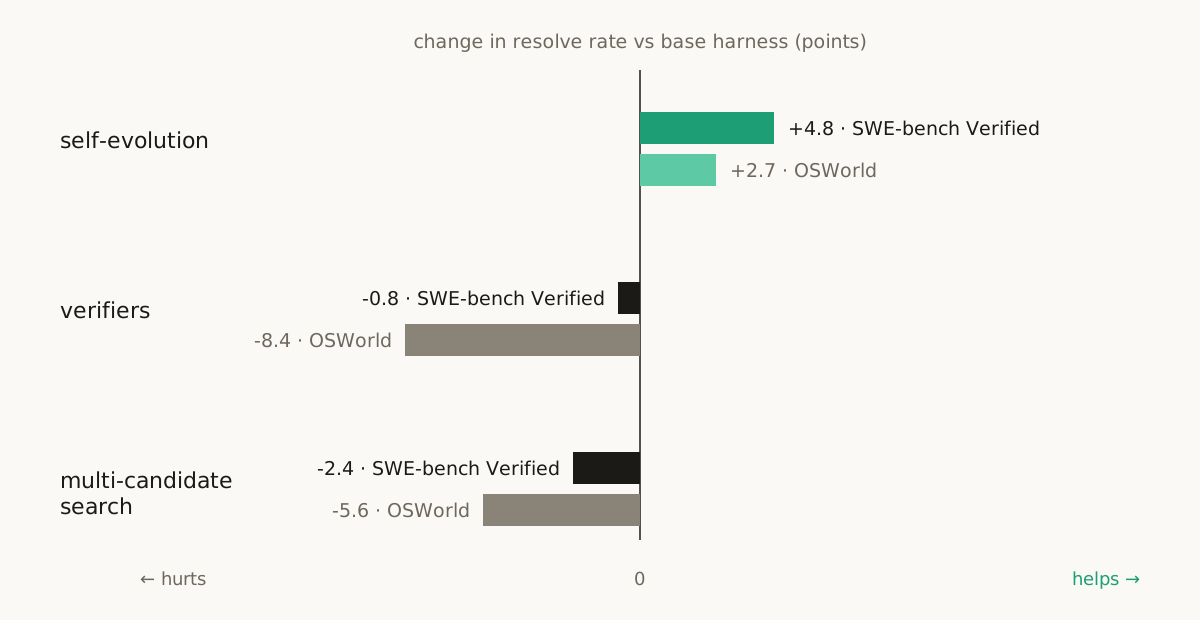
Self-evolution was the only consistently helpful module: plus 4.8 points on SWE-bench Verified and plus 2.7 on OSWorld, via an acceptance-gated attempt loop that stays narrow until failure signals justify broadening. Verifiers, the module everyone’s instinct says to add, hurt: minus 0.8 and minus 8.4. Multi-candidate search hurt too: minus 2.4 and minus 5.6. The one survivor is the module that narrows the agent’s attempt loop, and everything that broadened the search made things worse.
The headline finding came from a different experiment. The researchers took OS-Symphony, a native code harness for desktop automation, and migrated its logic into NLAH representation. Same strategy, same model, different representation. Performance jumped from 30.4% to 47.2%. Runtime dropped from 361 minutes to 141. LLM calls collapsed from 1,200 to 34. The representation itself drove the gain, replacing brittle GUI repair loops with durable runtime state and artifact-backed completion.
Two patterns stand out in the full results. Roughly 90% of all compute flows through delegated child agents, not the parent, which means the harness is an orchestration pattern rather than a reasoning pattern: it decomposes, delegates, and verifies. And in every configuration tested, narrowing the loop beat broadening the search.
The Stanford paper: optimizing the harness automatically
Meta-Harness treats the harness as an optimization target and lets a machine search for the right one. It comes from a Stanford team including Omar Khattab, the creator of DSPy. DSPy tunes prompts within a fixed pipeline. Meta-Harness rewrites the pipeline itself: structure, retrieval, memory, orchestration topology.
The loop works like this. An agentic proposer (Claude Code running Opus 4.6) reads the failed execution traces of prior candidates, diagnoses what broke, and writes a complete new harness. Scores and raw traces accumulate in a growing file system. An evaluator tests each proposal. Repeat.
The scale is striking: about 10 million tokens per iteration, 400 times more feedback than prior text-optimization methods, 82 files read per round. Those traces turn out to be irreplaceable. Remove them and accuracy drops from 50% to 34.6%. Replace them with summaries and you get 34.9%, barely better than nothing. The signal lives in the raw traces; compression destroys it.
The results change the calculus of model choice. On Terminal-Bench 2, Meta-Harness scored 76.4%, the only automatically optimized system in a field of hand-engineered entries. It reached rank two with Opus and rank one with Haiku: a smaller model outranking larger ones through harness optimization alone. On a 215-class text classification task it hit 48.6% accuracy, 7.7 points above the prior state of the art, using four times fewer tokens. And a harness optimized on one model transferred to five others, improving all of them.
The asset that transfers, the thing worth investing in, is not the model. It’s the harness.
Constraints and safety complete the picture
Two more systems fill in the edges. DeepMind’s AutoHarness compiles game rules into code harnesses, eliminating 100% of illegal moves across 145 games; one variant replaces the LLM entirely and runs the decision policy as pure code. And AgentSpec provides safety constraints as a domain-specific language, preventing over 90% of unsafe executions in evaluation.
Put the four systems side by side and they read as facets of one discipline: representation, optimization, constraints, safety.
Three eras, and a craft of subtraction
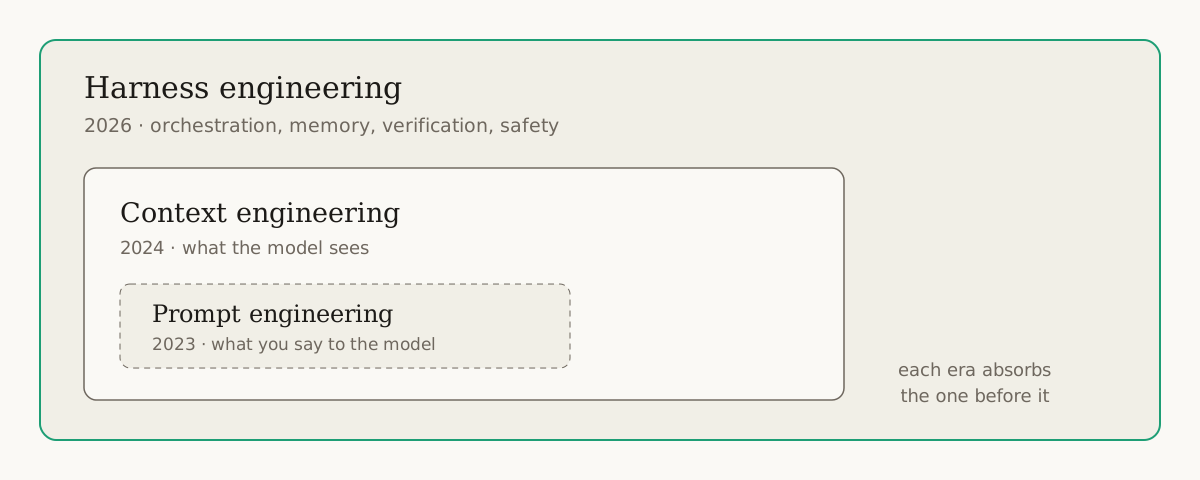
This discipline sits in a longer arc. Prompt engineering gave way to context engineering, which is now giving way to harness engineering. Three eras in four years, each absorbing the one before it: harness engineering contains the prior two and adds what the model can’t do on its own, from orchestration and memory through verification and safety.
In practice the discipline takes on an odd shape, and it rhymes with the ablation results. Anthropic named the dynamic: every harness component encodes an assumption about what the model can’t do alone, and those assumptions expire. When Opus 4.6 stopped needing context resets, Anthropic dropped them entirely. Manus rewrote their harness five times in six months. Vercel removed 80% of an agent’s tools and got better results.
The harness space doesn’t shrink as models improve. It moves. That is why mature harness work looks less like adding structure and more like deleting it on schedule, as the assumptions underneath expire.
If you build agents, you are a harness engineer
The practical takeaway is simple. On the same model and the same benchmark, harness quality can produce a six-times performance gap, so investing in your harness yields larger, faster, and more reliable gains than waiting for the next model upgrade. The question is less which model to pick and more which structure to remove.
Open problems remain, and they’re not small. Portable harness logic lowers the barrier to spreading risky workflows: prompt injection buried in harness text, malicious tools grafted into shared artifacts. One audit found that one in four community-contributed agent skills contains a vulnerability. And the most consequential open question sits further out: can harness and model weights be co-evolved, letting strategy shape what the model learns and the model reshape the strategy that wraps it?
Harness engineering is moving from folklore to measurement. The layer between a language model and useful work always carried more weight than it got credit for. Now it has a name, two papers, and a benchmark trail. And like any other system, it rewards careful engineering.
Sources
- Natural-Language Agent Harnesses, Pan et al., Tsinghua University, March 2026
- Meta-Harness: End-to-End Optimization of Model Harnesses, Lee, Nair, Zhang, Lee, Khattab, and Finn, March 2026 (code)
- Building effective agents, Anthropic
- AGENTS.md, the emerging convention for agent-readable project instructions
- PY’s video survey Rethinking AI Agents: The Rise of Harness Engineering, which first connected these papers for me